

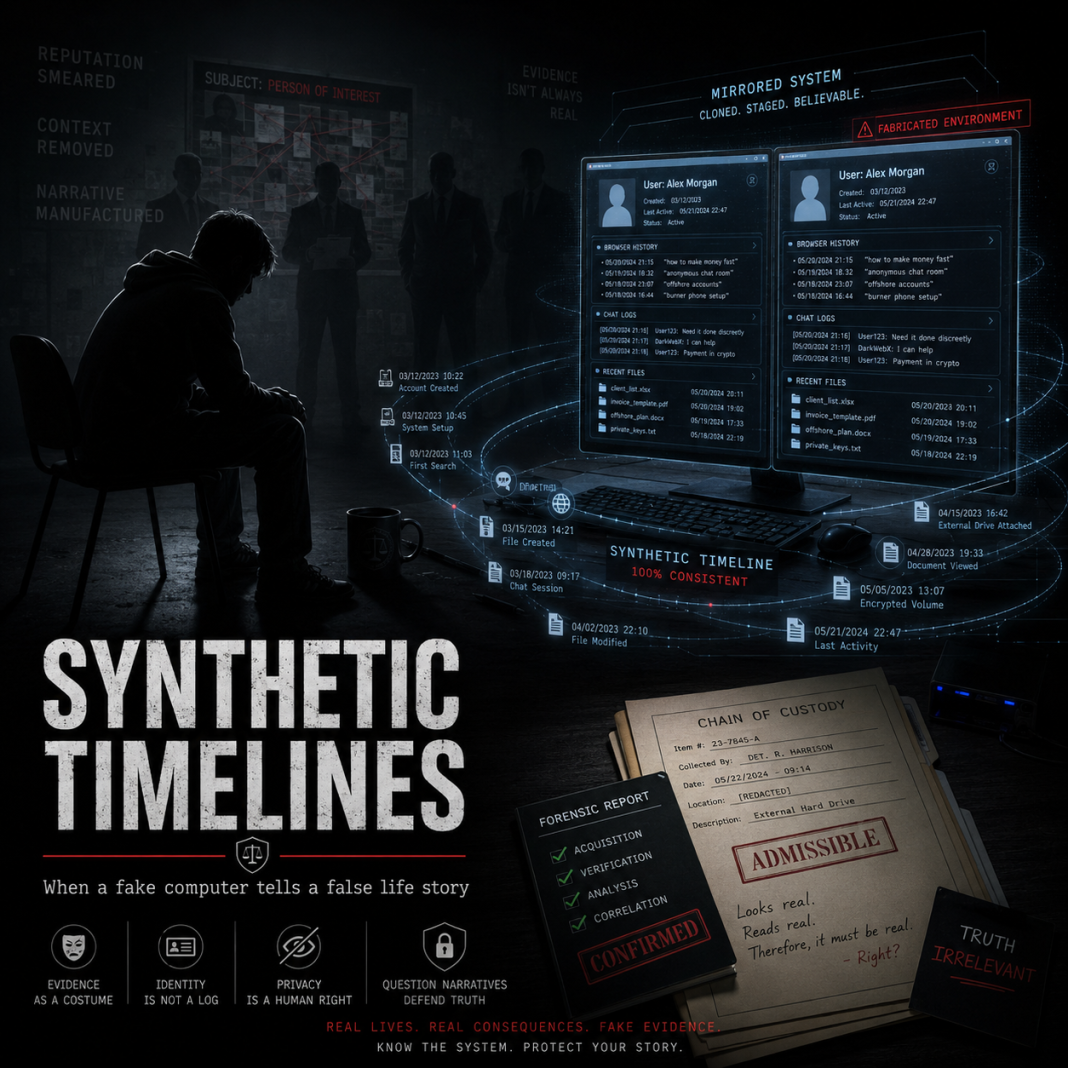
Synthetic Forensic Timelines: When a Fake Computer Tells a False Life Story
A digital forensics threat model about staged systems, mirrored machines, reputation destruction, and the weaponization of metadata.
A planted file is crude. A staged computer timeline is a whole fake life wearing your name.
Digital evidence is powerful because it looks objective. That is also why it is dangerous. A computer can contain real artifacts and still tell a false story.
This is the nightmare at the center of the synthetic forensic timeline problem: not a single fake file, but an entire artificial behavioral history built to impersonate a person’s life.
Disclaimer: This Is a Threat Model, Not an Accusation
This article is a threat-modeling essay about forensic integrity, civil liberties, digital evidence abuse, and anti-forensics as a defensive discipline.
It is not an accusation against any specific agency, officer, investigator, court, contractor, company, or case. The goal is to describe how a malicious actor, corrupt insider, compromised investigator, or institutionally protected group could theoretically construct a fake digital narrative around a person and then use that narrative to mislead others.
Because apparently humanity looked at computers and thought, “What if we made ghosts admissible in court?” Marvelous. Horrific. Very on-brand for the species.
What Is a Synthetic Forensic Timeline?
A synthetic forensic timeline is a constructed or manipulated sequence of digital artifacts designed to create the appearance of organic user behavior, intent, identity, or instability.
It is not merely a suspicious file appearing on a device. It is the appearance of a whole digital life.
- staged account creation
- backfilled user activity
- fake browser searches
- planted documents
- artificial file access times
- fabricated chat logs
- cloned profile structures
- staged external drive activity
- manufactured signs of instability
- deceptive communications metadata
- fake “intent” artifacts
- controlled timestamps
- selectively curated system logs
The goal is not just to plant evidence. The goal is to manufacture personhood.
One file screams. A thousand mundane artifacts whisper, “This is normal. This is real. This person was here.” And because most humans have the forensic literacy of a haunted toaster, they believe the whisper.
The Mirror Machine Scenario
Imagine a witness, dissident, whistleblower, inconvenient technical expert, political opponent, family-law target, business rival, or vulnerable civilian becomes inconvenient.
Before any formal action happens, the person is socially prepared for disposal. Their reputation is attacked. They are described as unstable, paranoid, dangerous, obsessive, delusional, unreliable, threatening, “not credible,” or “a problem.”
This matters because reputation destruction creates the emotional runway for evidence abuse. Once people believe someone is unstable, they become easier to frame.
Then a staged system appears.
A mirrored or fabricated computer environment is built to look like it belongs to the target. It may contain copied documents, profile folders, browser artifacts, fake searches, cached pages, recently opened files, misleading communications, artificial timestamps, suspicious folders, staged logs, and fragments of truth mixed with fabrication.
This is the mirror machine. Not a computer. A costume. A machine wearing a person’s life.
Why a Fake Computer Is More Dangerous Than a Fake File
A planted file can be challenged. A staged timeline is harder because it creates context.
It does not say, “Here is one suspicious artifact.” It says, “Here is the pattern.”
Patterns are psychologically powerful. Investigators, attorneys, journalists, coworkers, family members, and judges may not understand the technical construction, but they understand narrative.
- The target was called unstable. Now the computer “proves” instability.
- The target was called dangerous. Now the computer “proves” intent.
- The target was called dishonest. Now the computer “proves” deception.
This is how synthetic evidence becomes narrative glue. A fake timeline binds together every rumor that came before it. Cute little legal necromancy. Very civilized. Bring a clipboard.
The Most Dangerous Phrase in Digital Forensics
“The computer shows…”
No. The computer does not “show” anything by itself. A computer contains data. People interpret data. People select artifacts. People create reports. People omit context. People misunderstand timestamps. People overstate findings. People lie.
The correct question is not simply, “What does the computer show?”
- Was this the original device?
- Who physically controlled it?
- When was it acquired?
- Was it live when seized?
- Was it powered off?
- Was it imaged properly?
- Was a write blocker used?
- Is there a cryptographic hash?
- Is there a full chain of custody?
- Are logs consistent with external records?
- Are timestamps internally coherent?
- Does the system show signs of staging?
- Does activity correlate with the alleged user’s real life?
- Does the evidence prove use, or merely existence?
Because “it exists on a system” is not the same as “this person did it.” Existence is not authorship. Presence is not intent. Metadata is not a soul.
Evidence as Costume
A staged system can dress itself in legitimacy. It can wear correct usernames, familiar directory names, believable browser patterns, normal application artifacts, old documents, copied photos, expected software, operating system history, staged mistakes, fake clutter, and realistic timestamps.
The realistic fake is not perfect. It is believable.
Real systems are messy. A fabricated system that looks too clean may be suspicious. But a fabricated system with ordinary mess can look convincing because it mimics the boredom and friction of real life.
- failed downloads
- half-written notes
- boring searches
- abandoned folders
- update logs
- cache debris
- temporary files
- normal user friction
- inconsistent but plausible behavior
That is how evidence becomes a costume. Reality is chaotic. A staged story has plot structure. And bureaucracies love plot structure like raccoons love trash.
The Reputation Smear Phase
A synthetic timeline becomes more powerful when preceded by reputation destruction.
- Identify a target.
- Isolate them socially.
- Spread rumors.
- Encourage third parties to see them as unstable.
- Trigger emotional reactions.
- Document those reactions out of context.
- Build a fake digital environment.
- Introduce staged evidence.
- Claim the evidence confirms the rumors.
- Use the combined narrative to justify escalation.
This is not merely technical. It is psychological. The machine becomes credible because the social environment was prepared first.
The server rack did not replace the mob. It gave the mob timestamps.
Synthetic Instability
One of the most dangerous uses of staged digital evidence is manufacturing the appearance of instability, intent, obsession, deception, or threat.
That can be attempted through search queries, notes, journal fragments, bizarre saved pages, staged messages, angry drafts, misleading screenshots, fake account activity, artificial late-night usage, or curated obsessive-looking patterns.
Once someone is framed as unstable, their denials can be folded back into the accusation. If they object, they are “defensive.” If they explain, they are “spiraling.” If they demand forensic review, they are “obsessive.” If they identify inconsistencies, they are “paranoid.”
That is the Kafka trap with a USB adapter.
Why Chain of Custody Is Not Bureaucratic Theater
Chain of custody is not paperwork decoration. It is the spine of forensic truth.
Without chain of custody, digital evidence becomes a haunted object passed between interested parties.
- Who collected the device?
- Where was it collected?
- When was it collected?
- Who had access?
- How was it transported?
- How was it stored?
- Was it powered on?
- Was it modified?
- Was imaging performed?
- Who performed imaging?
- What tools were used?
- What hashes were generated?
- Do those hashes match later analysis?
When custody is weak, the question changes. Not “What did the evidence show?” but “Who had the opportunity to make it show that?”
Original Device vs. Constructed Environment
One of the first forensic questions should be: Is this the original system, or a constructed environment?
A constructed environment may involve virtual machines, cloned drives, restored backups, copied user profiles, staged operating system installs, mounted disk images, artificial registry hives, synchronized file trees, manipulated filesystem metadata, scripted user activity, imported browser profiles, or copied application data.
A system can look personal without being historically personal. A desktop folder named after a person is not proof of authorship. A browser profile is not proof of identity. A logged-in account is not proof of control. A timestamp is not proof of life.
What Should Be Correlated?
A synthetic timeline becomes weaker when forced to correlate with external reality.
- ISP records
- router logs
- DHCP leases
- Wi-Fi association logs
- VPN logs
- mobile carrier records
- cloud login history
- email provider logs
- password manager records
- MFA events
- physical access logs
- CCTV or badge records
- phone location
- financial transactions
- witness timelines
- work schedules
- operating system installation history
- USB device history
- filesystem journal artifacts
- prefetch data
- shellbags
- link files
- browser sync records
- endpoint security telemetry
The key question is simple: Did the alleged digital life intersect with the person’s physical life?
If a computer claims the user was active at home while the person was elsewhere, the story cracks. If browser activity exists but network records do not support it, the story cracks. If staged files appear without organic access history, the story cracks. If timestamps cluster unnaturally, the story cracks.
A synthetic timeline hates external reality. External reality is the bleach.
Signs of Possible Timeline Construction
- unnatural bursts of activity
- overly convenient timestamps
- too-perfect narrative sequencing
- repeated access patterns inconsistent with human use
- missing mundane artifacts
- mismatched install dates
- inconsistent timezone evidence
- artifacts created before accounts existed
- file access times inconsistent with application logs
- browser history without supporting cache or session evidence
- communications without provider-side correlation
- documents with metadata inconsistent with alleged authorship
- cloned profile paths
- VM artifacts where none are expected
- hardware identifiers inconsistent with known devices
- operating system install dates inconsistent with ownership history
- sudden appearance of incriminating behavior after smear activity begins
- lack of physical-world corroboration
One anomaly does not prove staging. The point is that the forensic story must survive hostile scrutiny. If the story collapses when provenance is tested, it was never evidence. It was theater. Bad theater. With subpoenas.
The Anti-Forensics Angle
The phrase anti-forensics is often misunderstood. People hear it and think, “tools criminals use to hide.” That is the shallow version.
A stronger definition is this: anti-forensics is the study of how digital evidence can be hidden, altered, destroyed, misdirected, fabricated, misunderstood, or overtrusted.
That includes criminal evasion, yes. But it also includes defense, civil liberties, auditability, false-positive resistance, evidence integrity, and institutional abuse prevention.
A society that does not understand anti-forensics cannot reliably detect forged evidence. If only attackers study manipulation, defenders remain obedient little evidence-consumption livestock. Adorable. Fatal.
Digital Evidence Should Not Be Treated Like Scripture
Digital artifacts are not holy relics. They are traces. Traces require interpretation. Interpretation requires humility. Humility requires independent review. Independent review requires access. Access requires due process.
- Where did this system come from?
- Who touched it?
- Was it original?
- Was it altered?
- What tool produced this finding?
- Can the finding be reproduced?
- What artifacts contradict the theory?
- What exculpatory data exists?
- What external records support or refute the timeline?
- What assumptions were made?
- What was excluded from the report?
A forensic report should not be a sermon. It should be a map. And every map should show the cliffs.
Defense-Side Review Checklist
In any high-stakes case involving suspicious computer evidence, defense-side experts should demand review in five major areas.
1. Device Provenance
- proof the device belonged to the alleged user
- purchase records
- serial numbers
- repair history
- known hardware identifiers
- physical possession history
- location history
2. Acquisition Integrity
- original forensic image
- hash values
- imaging logs
- write-blocking details
- tool versions
- examiner notes
- photos of seized equipment
- collection environment
3. Custody Review
- full chain-of-custody documentation
- storage logs
- access logs
- transfer records
- who had physical access
- who had administrative access
4. Timeline Validation
- operating system install dates
- user profile creation dates
- filesystem activity
- logon events
- file access artifacts
- browser activity
- application usage
- USB history
- network activity
- timezone consistency
5. Alternative Hypotheses
- staging
- cloning
- profile import
- malware
- remote access
- account compromise
- shared device use
- VM or container usage
- insider manipulation
- automated activity
- timestamp alteration
- evidence contamination
The goal is not to invent excuses. The goal is to stop a machine from being mistaken for a person.
A Simple Principle
A system should not be trusted merely because it looks complete.
Completeness can be forged. Consistency can be engineered. Narrative can be manufactured.
Real human digital life is weird. It contains friction, contradiction, boredom, error, distraction, and accidental context. A synthetic timeline often tries too hard to be meaningful. That is its weakness.
It wants to be believed. Evidence should not want anything.
Why This Matters for Privacy Activists
Privacy is often framed as secrecy. That is wrong. Privacy is the ability to maintain control over the boundary between the self and the world.
When digital systems can be used to impersonate your life, privacy becomes identity defense.
A person’s devices now function as diaries, witnesses, maps, memory prosthetics, social records, workspaces, political archives, financial records, emotional residue, and behavioral evidence.
If those systems can be mirrored, staged, or manipulated, then identity can be reconstructed without consent. Not stolen. Authored. By someone else.
Closing: Metadata Is Not a Soul
Digital evidence is powerful. That is why it must be treated with suspicion, not worship.
A fake computer can be built. A fake timeline can be staged. A fake behavioral profile can be manufactured. A fake person can be constructed from real fragments.
So ask better questions.
- Not “What did the computer show?” Ask: “Who made this machine speak?”
- Not “Do the artifacts exist?” Ask: “Do they prove a real human life was lived through this device?”
- Not “Is the timeline consistent?” Ask: “Is it organic?”
Evidence should establish truth. It should not become a manufactured biography. And it should never become a tombstone with timestamps.
A fake machine does not need to prove everything. It only needs to make the lie feel organized.
Suggested Terms
- synthetic forensic timeline
- constructed digital biography
- mirrored system
- staged computing environment
- artifact laundering
- metadata impersonation
- behavioral evidence fabrication
- identity reconstruction attack
- forensic narrative poisoning
- evidence-as-costume
FAQ: Synthetic Forensic Timelines
What is a synthetic forensic timeline?
A synthetic forensic timeline is a constructed or manipulated sequence of digital artifacts designed to make it appear that a person organically used a computer system over time.
How is a synthetic timeline different from a planted file?
A planted file is a single suspicious object. A synthetic timeline is broader. It attempts to create context, behavior, intent, and identity through many artifacts arranged into a believable pattern.
Why does chain of custody matter in digital forensics?
Chain of custody documents who handled evidence, when it was handled, how it was stored, and whether the evidence could have been altered. Without it, digital evidence becomes much harder to trust.
Can a computer contain real artifacts but still tell a false story?
Yes. Real files, logs, timestamps, and metadata can be copied, staged, imported, misinterpreted, or arranged in a misleading way. The existence of artifacts does not automatically prove authorship, intent, or control.
How can a staged computer environment be challenged?
It can be challenged through device provenance, forensic imaging records, hash verification, chain-of-custody review, external log correlation, account authentication records, timeline analysis, and independent expert review.
Final line: A planted file is evidence fraud. A synthetic timeline is identity murder by metadata. Know the system. Protect your story.