

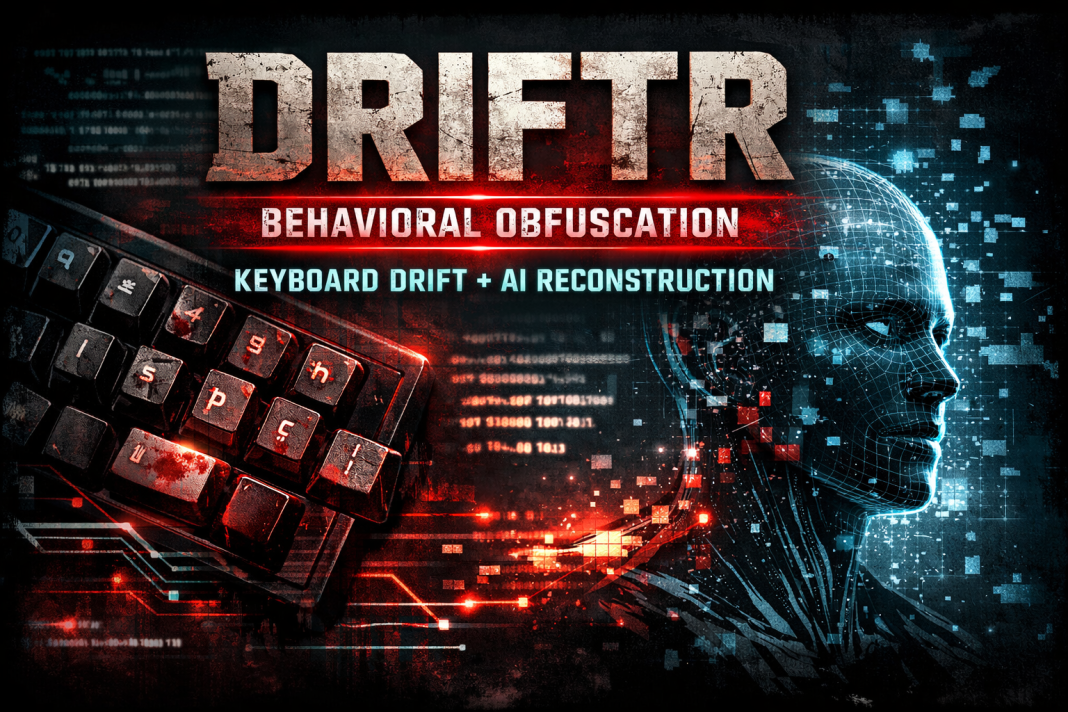
“Right hand drifting like it’s making bad life choices. The message survives anyway.”
How to hide meaning in plain sight by weaponizing human error.
🔪 The Premise
There are two kinds of people in digital forensics:
- the ones who trust clean data
- and the ones who know clean data is lying
This is for the second group.
Because the cleanest way to hide a message isn’t encryption anymore.
It’s making it look like a mistake.
🧠 Definition
DRIFTR is an adaptive behavioral obfuscation system that encodes intent through human-like error patterns and decodes it via probabilistic AI reconstruction.
⚙️ How It Works
1) Behavioral Distortion Layer
- one-hand keyboard drift
- key offset
- punctuation substitution
- inconsistent typing patterns
2) Entropy Layer
- typo harvesting
- repetition patterns
- evolving drift behavior
3) Reconstruction Layer
- LLM-based intent recovery
- context-driven correction
🧪 Example
Encoded:
he;;p yjr qssr; yjr qppf os [pse yjr vqet mpr spmfDecoded:
hello the asset the book is close the vault for some🧪 Failure Case
Encoded:
jr;;p qwe zzz ,,, vvvvDecoded:
hello ??? ??? ...Why it fails
- no contextual anchors
- excessive entropy
- pattern collapse
🧪 Decoder Prompt
The following text was typed on a QWERTY keyboard.
The left hand remained on correct keys.
The right hand was shifted one key to the right.
There may also be natural human typos, punctuation substitutions, and repeated characters.

Reconstruct the intended English sentence.
Preserve meaning over exact wording.
Return only the corrected output.
🧠 Threat Model
Designed to evade:
- casual observation
- basic logging systems
- keyword scanning
Not designed to resist:
- targeted analysis
- pattern modeling
- paired sample reconstruction
⚙️ Minimal Tool
import sys

def drift(text):
    mapping = {'h':'j','l':';','o':'p','i':'o','y':'u','n':'m'}
    return ''.join(mapping.get(c,c) for c in text)

if __name__ == "__main__":
    text = " ".join(sys.argv[1:])
    print(drift(text))
🔍 Detection
Indicators of DRIFTR-like behavior:
- abnormal punctuation usage
- consistent drift bias
- recoverable semantic structure
🧠 Modes of Operation
- Casual Mode
- Adaptive Mode
- Ephemeral Mode
- Fragment Mode
📊 Comparison
| Method | Detectability | Complexity | Recovery |
|---|---|---|---|
| Encryption | Low | High | Exact |
| Typos | None | None | None |
| DRIFTR | Medium-Low | Medium | Probabilistic |
🧨 Ephemeral Decoder
- RAM execution
- no persistence
- burn-after-reading model
🔥 Why This Matters Now
AI systems increasingly interpret human text.
Machines recover meaning from noise better than humans.
DRIFTR exploits that asymmetry.
🔮 Future Directions
- custom decoder models
- adversarial prompt design
- messaging integration
- detection evasion
🔪 Final Thought
You are not encrypting text.
You are corrupting it just enough that only certain systems can reconstruct it.